Since hostilities in the Gulf began on 28 February 2026, contractors, employers and consultants across the region have been forced to confront a question that most FIDIC and bespoke construction contracts were never really drafted for: what happens to time and cost entitlement when the disruption isn't a design change or a weather event, but a regional conflict affecting shipping lanes, insurance markets, air travel and labour mobility all at once?
This guide sets out, in practical terms, how contractors and employers in the UAE, Qatar and Saudi Arabia should be thinking about force majeure, extension of time (EOT) entitlement, and forensic delay analysis in the current environment — and where the evidentiary and procedural pitfalls lie.
The scale of the disruption
The conflict's effect on the Gulf construction sector has been real, but uneven — and the data so far tells a story of resilience under strain rather than collapse.
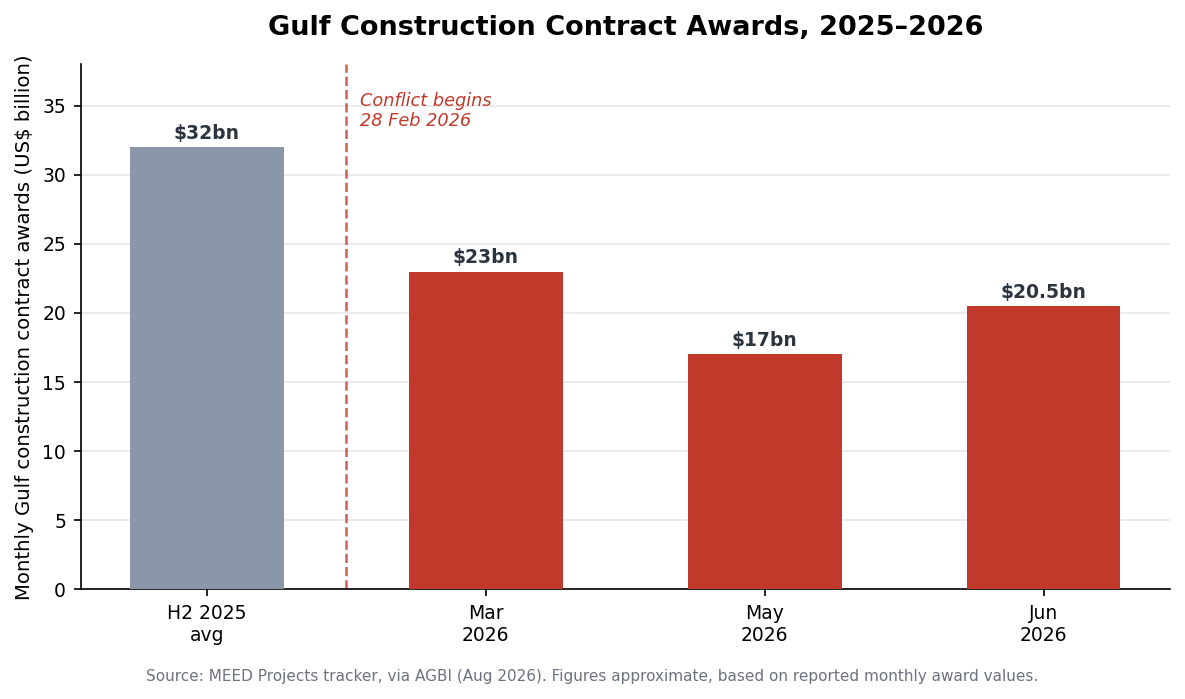
Monthly Gulf-wide contract award values, tracked by MEED Projects, averaged around $32 billion in the second half of 2025. Following the conflict's onset, awards fell to $23 billion in March, dropped further to $17 billion in May, and partially recovered to $20.5 billion in June — still roughly a third below the prior year's pace. Qatar has been the clearest laggard: after one large contract pushed February awards to $8.5 billion, monthly values stayed under $50 million for three straight months. The UAE and Saudi Arabia have fared comparatively better, with Saudi awards more than quadrupling year-on-year in June even as the broader region slowed.
Behind the headline award figures sits a deeper cost story. The Strait of Hormuz, which carries roughly a fifth of global oil and LNG trade, has seen sharply reduced vessel traffic amid security concerns and rising war-risk insurance premiums — at points compounded by statements from Iran's Revolutionary Guard signalling the strait was effectively closed to shipping. Even without a formal closure, carriers have rerouted or delayed sailings, and industry estimates suggest shipping rates on affected routes could rise 50–80% if conditions persist.
That is feeding directly into tender and building costs.
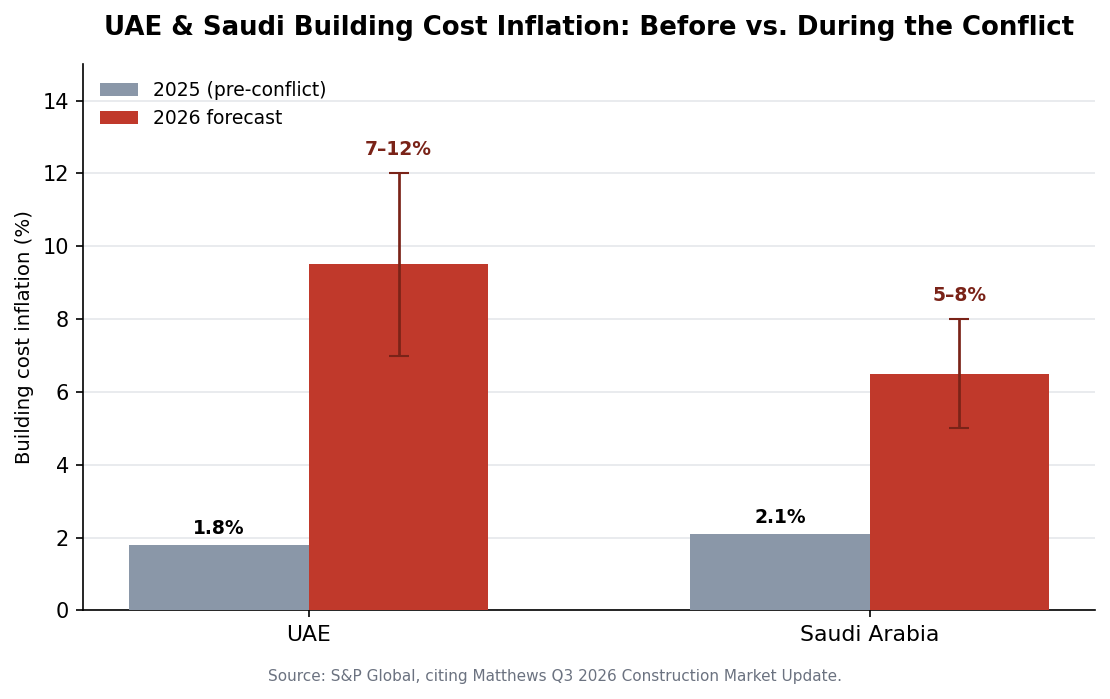
Matthews' Q3 2026 Construction Market Update, cited by S&P Global, forecasts UAE building cost inflation of 7–12% in 2026, up from just 1.8% the year before — driven by fuel, freight and insurance costs feeding through into contractor pricing. Saudi Arabia's forecast range is 5–8%, up from 2.1%. Periodic airspace closures and flight suspensions have also disrupted the mobile expatriate workforce the GCC construction sector depends on, from site engineers to specialist technicians.
Crucially, most contractors report that the majority of sites have continued operating without disruption — a minority of projects have paused, generally at the request of authorities or because of proximity to strategically sensitive locations. This matters for claims purposes: entitlement has to be assessed project-by-project and event-by-event, not assumed at a regional level.
Force majeure: what it does and doesn't give you
Under FIDIC 2017 (Red, Yellow and Silver Books), an "Exceptional Event" under Sub-Clause 18.1 covers events or circumstances beyond a party's control that could not reasonably have been provided against, and that are not substantially attributable to the other party. War, hostilities, invasion, and acts of foreign enemies are expressly listed examples. Under FIDIC 1999, the equivalent mechanism sits in Clause 19 (Force Majeure), with a near-identical list.
That said, three points are consistently misunderstood by contractors trying to rely on it:
- A conflict occurring in the region does not automatically entitle every contractor on every project to relief. The event must actually have prevented performance of the specific obligation being claimed — a general climate of uncertainty, cost inflation, or workforce anxiety is not, by itself, an Exceptional Event under most drafting.
- Force majeure and EOT are not the same claim. An Exceptional Event may justify an EOT for the period the party was prevented from performing, but cost recovery under FIDIC 18.4 is considerably narrower — it typically excludes most force majeure events unless the contract specifically extends compensation (loss of profit is usually excluded outright).
- Time-bar and notice provisions still apply, and tribunals in the region have shown limited sympathy for parties who assume a conflict excuses them from formal notice. This is the single most common way otherwise-valid entitlement is lost.
- Issue notice early and often. Don't wait for the full cost or time impact to crystallise before triggering the 28-day notice period — a preliminary notice followed by particulars is safer than a single late, complete claim.
- Separate force majeure time relief from cost recovery claims, and check the specific compensation carve-outs in your contract's Exceptional Event / Force Majeure clause before assuming prolongation costs are recoverable.
- Maintain a conflict-impact log alongside the standard project diary — freight quotations, insurance premium changes, supplier force majeure notices, authority directives, and workforce mobility disruptions, each dated and cross-referenced to the affected activities.
- Commission delay analysis on a rolling basis rather than retrospectively at project close-out — the further removed the analysis is from contemporaneous events, the harder causation is to establish convincingly.
- Review escalation and price-adjustment mechanisms now, not after a dispute arises — several employers in the region are reportedly favouring contract renegotiation over termination or replacement precisely because of how disruptive re-tendering would be in the current market; a well-evidenced claim strengthens your negotiating position either way.
The notice timeline still governs everything
Whatever the underlying cause, the procedural clock under FIDIC 2017 does not stop for a conflict.
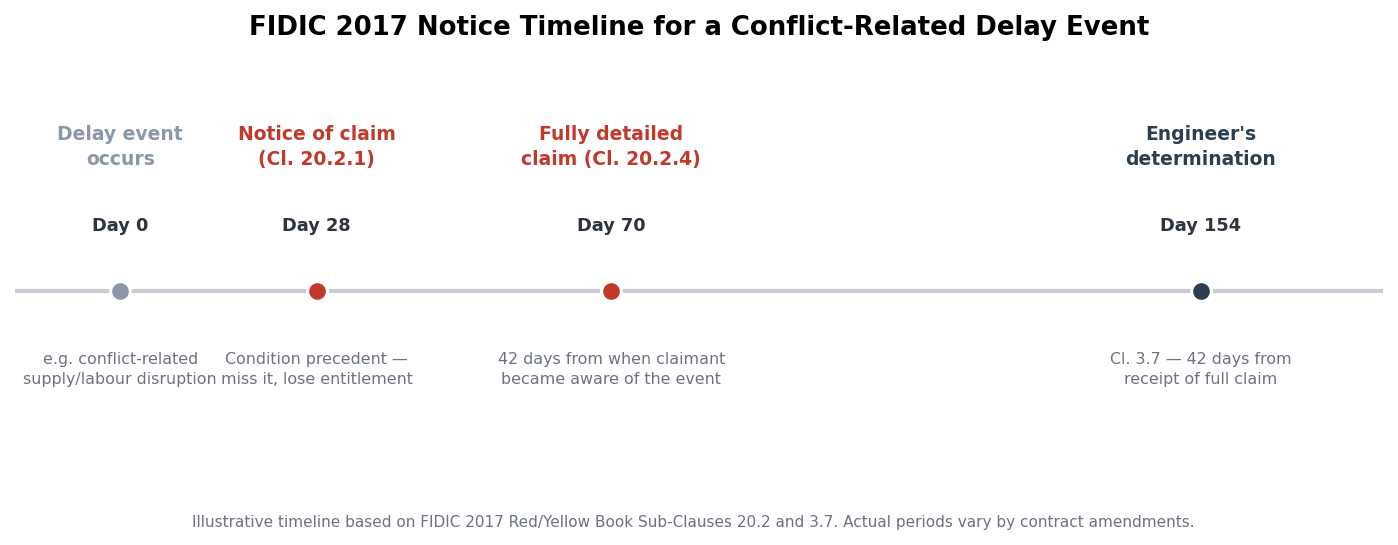
Under Sub-Clause 20.2, notice of a claim must be given within 28 days of the claiming party becoming aware, or when it should have become aware, of the event or circumstance giving rise to the claim. This is a condition precedent in most drafting — miss it, and entitlement can be lost even where the underlying cause is genuine and severe. A fully detailed claim, including full supporting particulars, is then due within 42 days of that awareness. The Engineer has a further 42 days under Sub-Clause 3.7 to issue a determination once the fully particularised claim is received.
For conflict-related disruption specifically, this creates a practical trap: many of the relevant impacts — a shipping delay, a war-risk insurance surcharge, a labour mobility restriction — develop gradually rather than as a single identifiable event. Contractors who wait to see how bad things get before issuing notice routinely find themselves outside the 28-day window. The safer approach is to issue notice on the earliest date the disruption becomes apparent, and to supplement with further notices as the impact develops — rather than waiting for a complete picture before notifying at all.
Building the delay analysis
Once notice is secured, the technical substance of the claim depends on the same forensic delay principles that apply to any EOT claim — applied to conflict-specific evidence:
Contemporaneous records matter more than usual. Because the underlying cause is regional and widely reported, tribunals will expect claimants to show the causal chain from the general conflict situation to the specific delay on the specific critical path activity — not simply assert that "the war caused delay." This means preserving procurement correspondence showing shipping delays and rerouting, freight and insurance invoices evidencing cost escalation, supplier notices of force majeure passed down the supply chain, and site records of any authority-directed stoppages or workforce unavailability.
Time Impact Analysis (TIA) remains the most defensible method for conflict-related events with a discrete trigger point (e.g. a specific shipment delay, a specific site stoppage order), since it models the event into the contemporaneous programme and isolates its critical path impact. Where disruption is more diffuse — cumulative cost escalation, intermittent labour shortages — a Windows Analysis across the affected period tends to hold up better, since it captures the net effect of overlapping causes within defined time windows rather than requiring a single fragnet.
Concurrency is likely to be a live issue. Where a contractor was already behind programme for reasons unrelated to the conflict, a tribunal will expect the analysis to separate the conflict-related delay from pre-existing contractor-culpable delay on the critical path. Conflating the two is the fastest way to have an otherwise legitimate claim discounted or rejected.
Quantum and time entitlement should be pleaded separately. Prolongation costs, materials cost escalation, and force majeure-related time relief often sit under different contractual mechanisms with different tests and different notice triggers — bundling them into a single narrative claim tends to weaken all three.
Practical recommendations
For contractors and employers navigating live or anticipated conflict-related disruption in the UAE, Qatar or Saudi Arabia:
How Novelite Consulting can help
Novelite Consulting LLC FZ prepares EOT claims, force majeure notices, and forensic delay analyses under FIDIC Red, Yellow, Silver and Gold Books, NEC and JCT contracts, for clients across the UAE, Qatar, Saudi Arabia and wider GCC. Our services include Time Impact Analysis, Windows Analysis and As-Planned vs As-Built methodologies, quantum and prolongation cost assessment, and expert witness reports for DIAC, ADGM, ICC, LCIA and DIFC-LCIA proceedings, compliant with the IBA Rules on the Taking of Evidence.
For a complimentary initial assessment of a conflict-related delay or claim, contact us at info@novelitepmc.com or +971 55 5989042.
---
Need an assessment of a conflict-related delay?
Novelite Consulting provides EOT claims, force majeure notices, forensic delay analysis, quantum assessment and expert witness support for construction disputes across the GCC.
Request an Initial AssessmentThis article is intended as general guidance and does not constitute legal advice. Entitlement under force majeure and Exceptional Event provisions depends on the specific wording of the contract in question and the facts of each case; specialist contractual and legal advice should be sought before relying on any of the above.
Sources: MEED Projects tracker (via AGBI, August 2026); S&P Global, citing Matthews Q3 2026 Construction Market Update; Abu Dhabi Commercial Bank / Arab News; Engineering News-Record; Zawya/TradeArabia News Service; Stimson Center; FIDIC 2017 Red/Yellow Book Sub-Clauses 3.7, 18.1, 18.4, 20.2.